
Why I Study History

It is past midnight. Two pages are open on my desk. A primary source from 1934. A 2026 article from one of the papers everyone trusts telling the same story without the parts that hurt.
This is the work. Most of it nobody sees.
I study history because nothing happens only once, and the people who recognize the second time can sometimes change it. That recognition is what lets a person, in the middle of whatever is happening, ask the two questions power doesn’t want asked: when has this happened before, and who benefited last time.
A reader who can ask those questions in real time is harder to govern by panic. That is the faculty under attack, and yours is the one they’re after — because you are the person sitting in the room while the changes are being made.
Power is not foolish enough to argue with the record. It has moved to the slower work — the executive orders, the curriculum revisions, the quiet deletions inside the agencies, the foundations and think tanks doing the legal drafting for whichever administration wants to use them.
A link dies. A curriculum committee picks the less troublesome verb. Somewhere in a national park, a sign comes down between two cabinet meetings. A grant is denied. An exhibit label passes through four offices and each one sands a little more off the original edge. Most of it happens at a pace too slow to register as removal. By the time you notice the shelf is shorter, you can no longer remember what used to be on it.
A film on the Haitian Revolution has been admired in theory and refused in practice for thirty years. The story has armies, betrayal, Napoleon, sugar, fire, and the only successful slave revolt in the modern Atlantic world; the obstacle, apparently, is that Hollywood keeps asking where the white heroes are. At Grand Canyon, a signpost naming what settlers did to the tribes that lived there is gone. A women’s history exhibit has disappeared from a federal site.
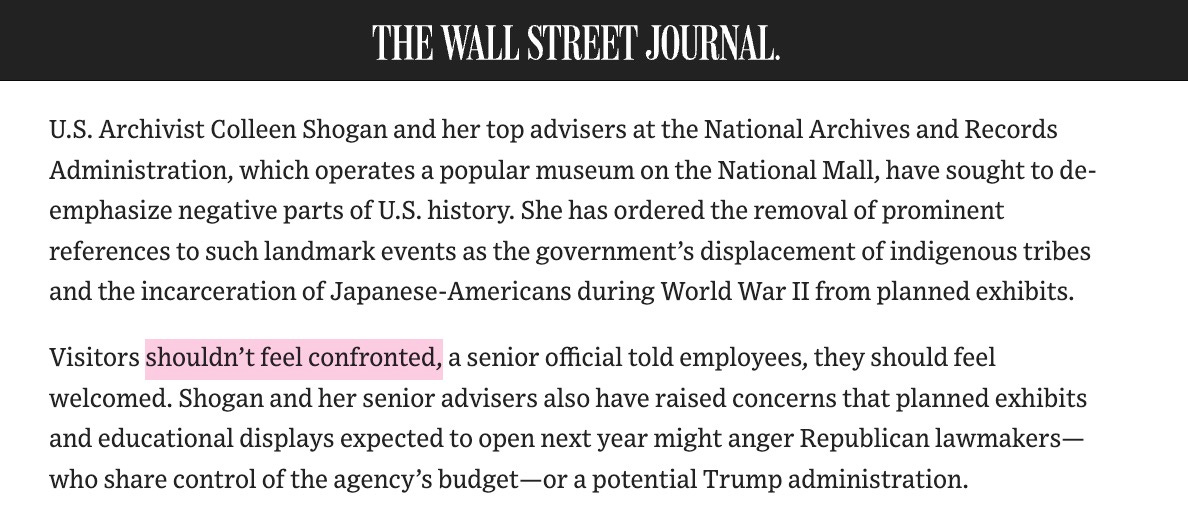
Somewhere in a museum, an exhibit is being rewritten under an order called Restoring Truth and Sanity to American History.
Some African traditions are less interested than ours in the wall between past and present. In Swahili, a person lives in sasa as long as someone alive still remembers them — the recent past, the near future, the present all held inside that span. When the last person who carries the name is gone, they cross into zamani, the deep past where the ancestors live.
What’s happening now is an attempt to force the crossing. To push names into zamani before their time, by policy, and on a schedule.
There is a Greek word for the kind of learning that feels like remembering. Anamnesis. The soul, Plato thought, knew everything before birth, and education was the work of recovery.
I’m not making the metaphysical claim. I’m describing what readers write to tell me happens when they meet real history for the first time. I did not learn this. I recognized it.
Anamnesis is why a reader, meeting real history for the first time, feels less instructed than reminded.
Which brings me to what you are reading right now, and how it stays here.
The Humanity Archive runs on a model older than the internet, and a stubborn one: no ads, no paywall, no corporate sponsor, no foundation board deciding which truths are safe to fund. The work stays open because a few readers choose to carry it.
A single essay takes ten to twelve hours from the first idea to the click of the publish button. My fingers on the keyboard, book pages dog-eared on the desk, a legal pad scribbled in notes only I can read filling up beside them. Some of it is verification: every quote, date, and name run through at least two sources before it lands. The rest is writing.
Right now about three percent of you are paid subscribers. Three percent funds the ninety-seven.
Most of you will never pay a cent, and the work is for you anyway.
A teacher whose curriculum was gutted reads for free because someone paid. A college student reads for free because a stranger decided to help instead of doing nothing. The retiree on a fixed income reads because someone with a little more room made space. The reader abroad at three in the morning reads because a person three thousand miles away refused to watch the work disappear.
A small group of readers pays so a much larger group doesn’t have to. Many of you read for free because some of you pay. If three percent more of you joined the three percent already paying, the work would be sustainable for years. If you can afford to be one of the readers who carries it, I’m asking you to become a paid subscriber.
If you cannot, keep reading and keep sharing.
I'm already back at the desk with more pages and more notes only I can read. I'm outlining the next piece, the quiet parts of history that explain the loud parts of the present.
Let’s keep building.
— Jermaine
Notes & Sources
On the African concept of time
John S. Mbiti’s framework of sasa and zamani. https://en.wikipedia.org/wiki/Sasha_and_Zamani
Academic analysis of Mbiti’s two dimensions of time. https://www.emerald.com/reps/article/5/3/249/362747/Politics-lost-in-translation-the-African-concept
On anamnesis
Plato’s Meno introduces the theory of recollection. https://classics.mit.edu/Plato/meno.html
Plato’s Phaedo develops the theory further. https://classics.mit.edu/Plato/phaedo.html
Overview of anamnesis in Plato’s epistemology. https://en.wikipedia.org/wiki/Anamnesis_(philosophy)
On the Haitian Revolution film never made
The Guardian on Venezuela’s $18 million backing of Glover’s Toussaint Louverture film. https://www.theguardian.com/world/2007/may/21/film.venezuela
Academic analysis documenting Glover’s “where are the white heroes?” account. https://h-france.net/fffh/maybe-missed/happy-as-a-slave-the-toussaint-louverture-miniseries/
On the Grand Canyon signage removal
Washington Post on signs removed from seventeen national park sites. https://www.washingtonpost.com/climate-environment/2026/01/27/national-parks-signs-censorship/
NPR on the lawsuit and the specific Grand Canyon language about settlers displacing tribes. https://www.npr.org/2026/02/18/nx-s1-5718006/trump-national-parks-lawsuit
On the executive order rewriting museum exhibits
Full text of Executive Order 14253. https://www.whitehouse.gov/presidential-actions/2025/03/restoring-truth-and-sanity-to-american-history/
Bravo! Your work is essential. Its value far exceeding the amount asked to keep it arriving to our shore. As so much does at the margins these days. Thank you for working so ably and tirelessly to bring forward what would prefer to hide. To connect the timeline(s) so that we can see the sweep. To bring to light that which luxuriates undisturbed in the dark. It is a sacred work for the sake of the lot of us, humans, struggling mightily with our humanity. I thank you truly.
Such an important Writer!! I subscribe as a white person NOT for kudos but for the brilliant writing here. For Jermaine’s focus and integrity sharing history with facts alongside how I see him presenting the facts within his lived experiences and ancestral stories.
I share and encourage those in my circle to subscribe. Few even acknowledge I sent the piece.
I share to perhaps try and be the small amount of “fertilizer” to grow this space Jermaine has created with his time, and his heart, with those opening up to unlearn the “history” my white culture learned and fill that space with what was and IS real.
We cannot ever change what we do not acknowledge first.
Thank you Jermaine for continuing and doing so with integrity, directness and I just say without a wasted word on the page